Introduction
Maria Montessori, observing the child's innate drive to explore the world, recognised that sensory experience is the bedrock of all human intelligence -"The senses, being explorers of the world, open the way to knowledge" -and from this profound insight emerged the Sensorial Curriculum. Far more than mere play or sensory stimulation, this meticulously designed sequence of materials and activities help to refine a child's sensory apparatus by tactile exploration: sorting, matching and grading an array of materials. In the modern world, children are bombarded by a kaleidoscope of sensory impressions: colours, sounds, textures, smells, tastes, weights, temperatures, and shapes flood their awareness indiscriminately. The primary goal of the Sensorial curriculum is to help the child to classify and order this overwhelming influx of information, thus laying the essential groundwork for abstract thought and intellectual development.

"The mind of a little child is certainly not a blank when he begins the education of the senses, but his concepts are all confused. He begins to distinguish various traits in objects already known. He distinguishes quantity from quality and separates form from colour. He distinguishes dimensions in objects that are long or short, thick or thin, large or small. He separates colours into groups and calls them by name. He notices the varying intensities of colours, calling the two extremes light and dark. Finally, he distinguishes tastes from smells, lightness from softness, and sounds from noises. He succeeds through the education of his senses in ordering his mental images. This is the first act of ordering in his developing mind. This sense of order that has been acquired early is of utmost importance for later life."
- Maria Montessori, The Discovery of the Child, p.100. (2004)
Montessori believed that by isolating specific qualities like dimension, colour, texture, sound, or weight, and offering controlled, purposeful interaction, the child develops:
The ability to perceive subtle differences e.g., slight variations in shade, minute differences in pitch, gradations in texture or weight.
The mental capacity to categorise and sequence sensory input based on identifiable properties e.g., arranging cylinders by height/diameter, grading colours from light to dark.
Precise language -e.g., rough / smooth, loud / soft, thick / thin, dark / light- is introduced to label and communicate these sensory distinctions.
Concrete sensory experiences become the foundation for later abstract concepts in mathematics (seriation, geometry), language (descriptive words, comparisons), science (observation, classification), and art (aesthetics, composition).
Activities inherently involve comparing, contrasting, grading, and sequencing - fundamental mathematical processes.
Characteristics of the Sensorial Materials
Montessori sensorial materials are not toys; they are scientifically designed instruments. Each set isolates a single, specific quality and incorporates a built-in control of error, allowing the child to self-correct without constant adult intervention. Key characteristics include:
The Pink Tower focuses only on dimension (size), the Colour Tablets focus only on colour (hue, then tint/shade), and the Sound Boxes focus only on auditory discrimination. Isolation of one specific quality prevents confusion and allows for deep focus on the target attribute.
Beautifully crafted from natural materials like wood, glass, and fabric, the materials attract the child's interest and convey respect for their work.
Each material requires careful handling -carrying, placing, pairing, grading- developing fine motor control, coordination, and concentration, alongside sensory refinement.
Materials move from simple to complex and from concrete to abstract e.g.,
Solid Cylinders → Knobless Cylinders
Colour Box I → Colour Box II → Colour Box III.
Key Areas and Examples
The Roles of the Adult and the Child
The Montessori guide acts as a catalyst and observer, carefully presenting the materials with precise, minimal movements, then stepping back, leaving uninterrupted time for repetition and deep concentration, and it is through this self-directed, repetitive manipulation that the child refines their sensory perception and internalises concepts. At each stage, the child is the active agent, constructing their own intellect through purposeful engagement with the materials, so by providing a logical framework for organising sensory input, the Sensorial curriculum empowers the child to:
- Become a keen, precise observer of the natural and man-made world.
- Develop logical thinking and problem-solving skills rooted in concrete experience.
- Appreciate order, pattern, and beauty.
- Build a rich foundation of vocabulary and concepts essential for future academic learning.
- Cultivate concentration, coordination, independence, and a profound sense of satisfaction derived from mastery.
In essence, the Sensorial materials are keys to the world, helping the child to decipher and make sense of their universe. They transform the chaotic symphony of raw sensation into an ordered, intelligible, and beautiful composition, enabling the child to move confidently from the concrete world of experience and into the boundless realms of abstract thought and creative expression. It is a curriculum that truly honours the child as a sensorial explorer, laying the indispensable groundwork for a lifetime of engaged learning and understanding.
"From three to six years, children have a real 'sense hunger', they love to touch things, to fit different shapes together, to grade colours and musical sounds. The material is carefully gradated to satisfy the child's every need, and once the child has fixed his attention, he becomes a little individual, no longer an imitator."
- Maria Montessori, 'Maria Montessori Speaks to Parents', p. 22. (2017)
Sensorial Extensions


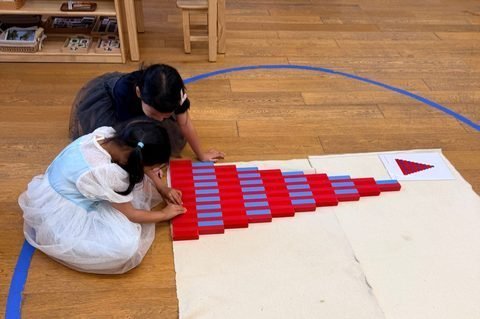
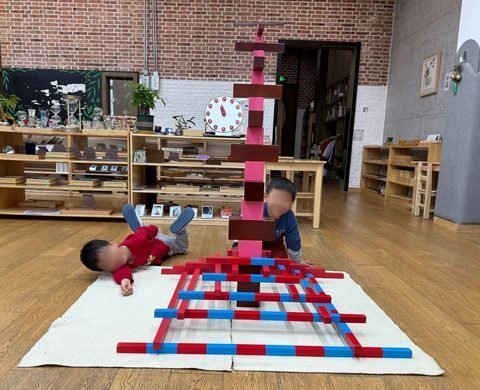
Sensorial extensions are tools for keeping the Sensorial area vibrant and deeply engaging for children who have mastered a particular material (or materials) and are ready for the next challenge. The child explores different ways of building, arranging or combining different Sensorial materials, unlocking their full potential and transforming them from isolated exercises into dynamic tools for ongoing discovery, creativity, and intellectual development. These expansions and variations are designed to:
Maintain interest and challenge after mastery of the primary presentation.
Solidify understanding of qualities (size, colour, shape, texture, sound, smell, weight, temperature).
Encourage independent thinking and novel uses of the materials.
Extend focused work periods and complex sequencing.
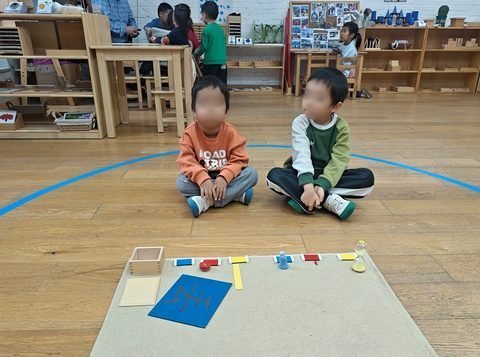
Many extensions naturally lend themselves to collaborative work.
Prepare for maths, language, geometry, art, and practical life by applying sensorial concepts in new contexts.
Characteristics of Sensorial Extensions
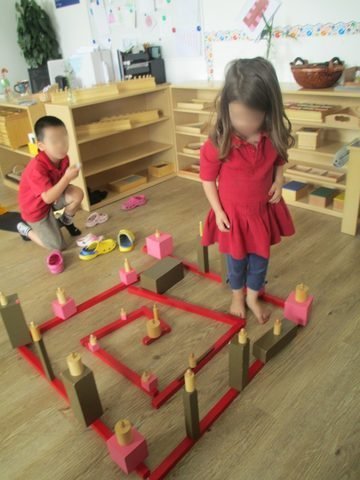
Often arise from a child's spontaneous exploration, but teachers can also present simple extension ideas to spark interest.
They utilise the material's inherent properties but combine or apply them in new ways.
Good extensions still focus on the key quality (e.g., gradation, matching) which the material isolates, even while combining materials.
There's often no single right answer; they encourage experimentation.
Like the core materials, the design often allows the child to see their own errors.
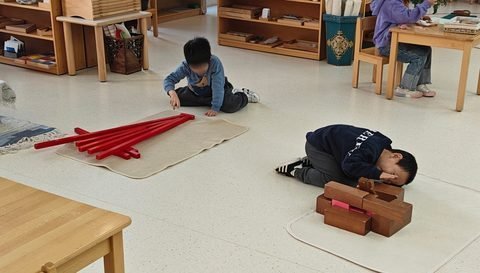

Principles for Using Extensions
Extensions should only be introduced after the child has mastered the primary presentation and exercises of the material.
The extension should still serve a sensorial purpose and isolate a quality effectively.
The best extensions begin with simple variations, allowing complexity to grow naturally.
Extensions are invitations, not requirements. Follow the child's interest.
Dimensional Material
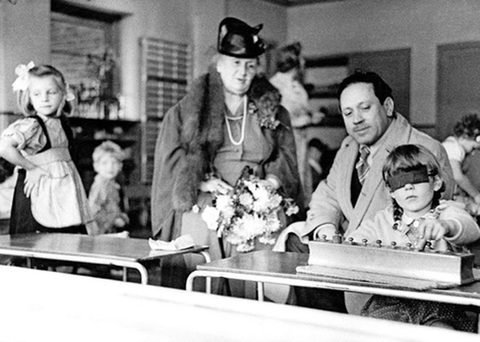
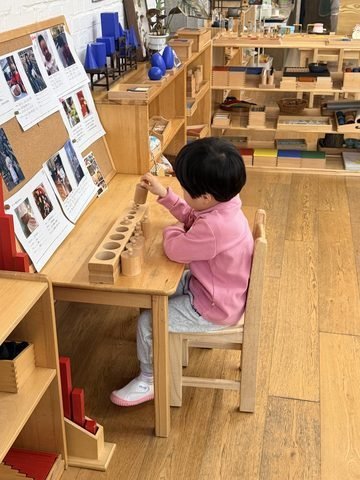
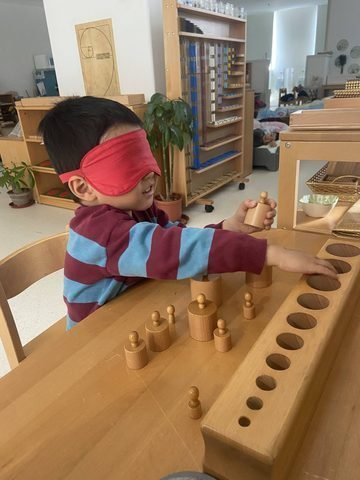
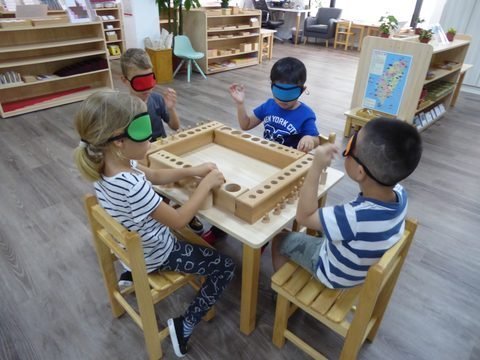
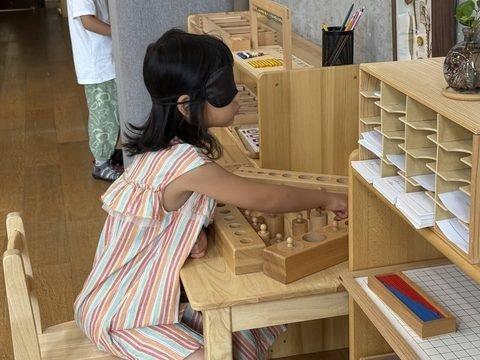
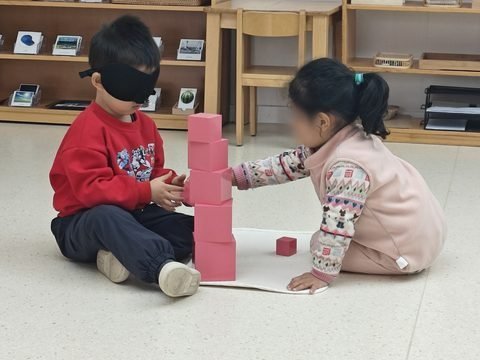
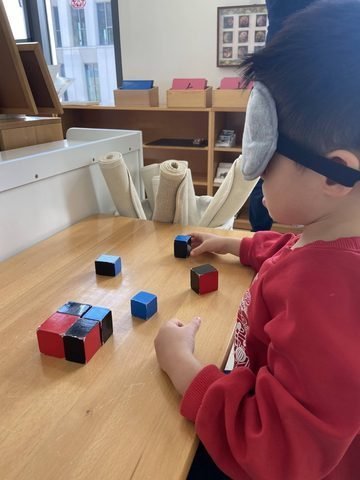
Children refine their Stereognostic Sense by using materials they have already mastered, but while wearing a blindfold. Tangentially related to the extensions, these activities increase the challenge and maintain the child’s interest in the Sensorial materials.
The Groups of Sensorial Materials
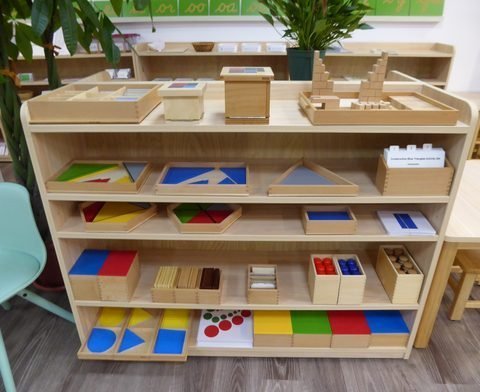
The materials are grouped by sense: Visual, Tactile, Complex, Stereognostic, Olfactory, Gustatory and Auditory.

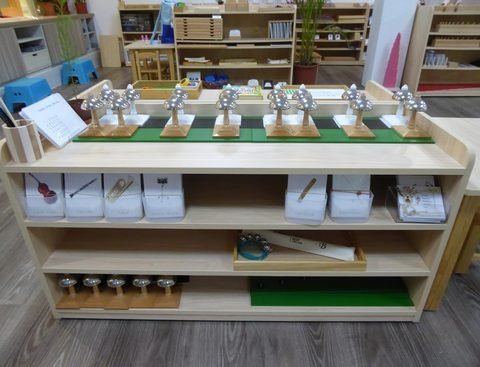

Visual Sense
Cylinder Blocks
4 blocks, each containing 10 cylinders with knobs, each knob fitting into its respective hole in the block.
The cylinders vary in 2 dimensions - length and breadth.
The diameter increases from 1 to 5.5cm. The height remains constant at 5.5cm.

The cylinders vary in 3 dimensions - length, breadth and height.
The diameter increases from 1 to 5.5cm. The height increases from 1 to 5.5cm.

The cylinders vary in 3 dimensions - length, breadth and height.
The diameter increases from 1 to 5.5cm. The height decreases from 5.5 to 1cm.

The cylinders vary in one dimension - height.
The diameter remains constant at 2cm. The height increases from 1 to 5.5cm.

Visual discrimination of dimensions.
Preparation for writing.
Preparation for Mathematics.
Refinement of the voluntary movement.




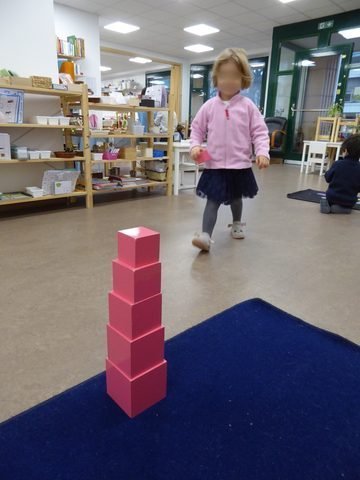
Pink Tower
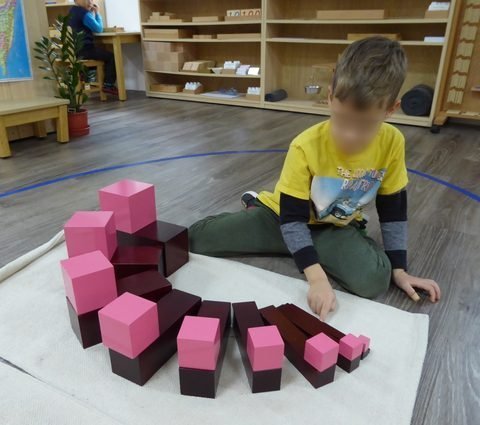
10 pink wooden cubes differing in 3 dimensions (length, breadth and height), ranging from 1cm3 to 10cm3.
Visual discrimination of differences in three dimensions.
Muscular education of the grip.
Preparation for Mathematics.
Preparation for refinement of voluntary movement.
Building horizontally.
Creating symmetrical patterns.
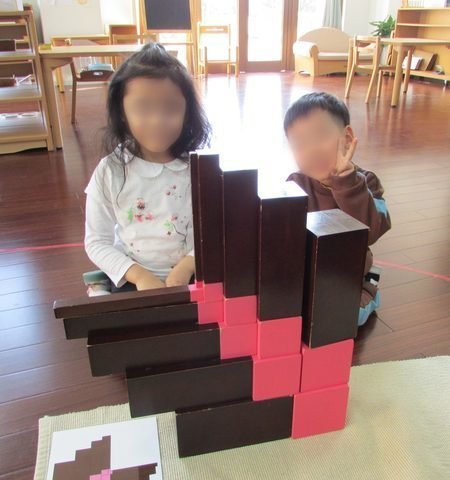
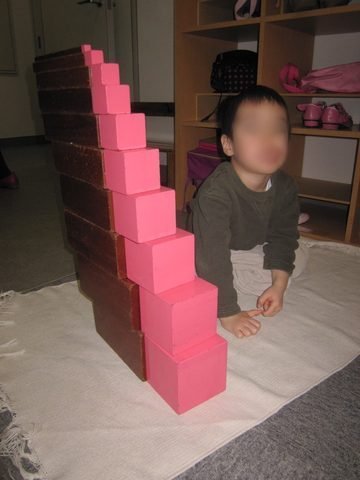
Combining with the Brown Stairs to build complex structures.







Brown Stairs
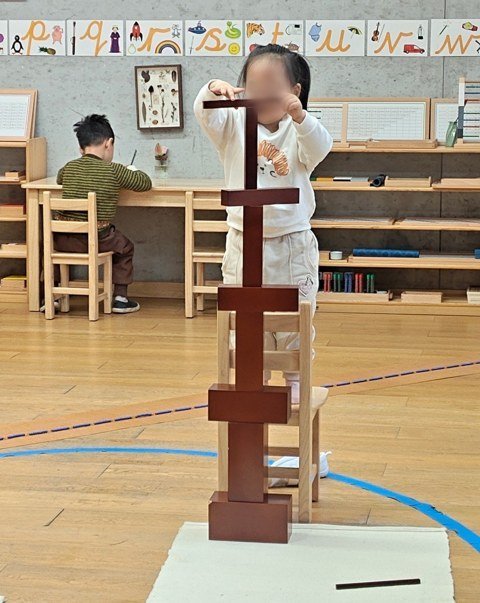
Ten brown wooden prisms of the same length, differing in two dimensions (breadth and height), with sides ranging from 1cm2 to 10cm2
Visual discrimination of differences in two dimensions.
Muscular education of the grip.
Preparation for Mathematics.
Refinement of the voluntary movement.


Lining up prisms on their thinnest (square) edges.
Creating bridges or enclosures.
Combining with Pink Tower to create complex structures or patterns.



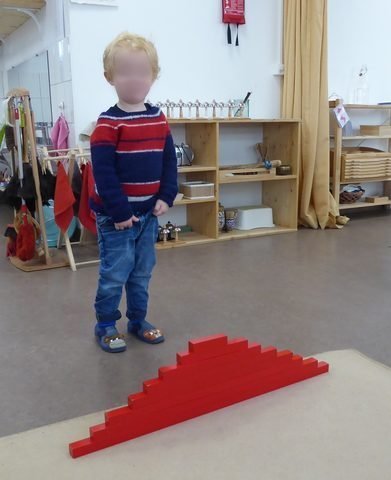
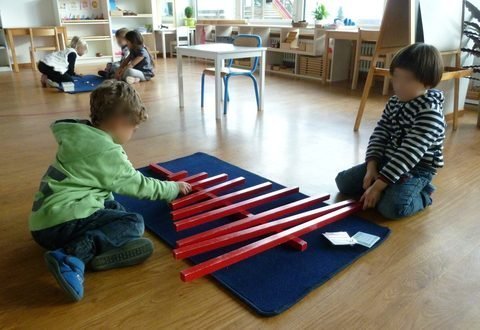
Red Rods
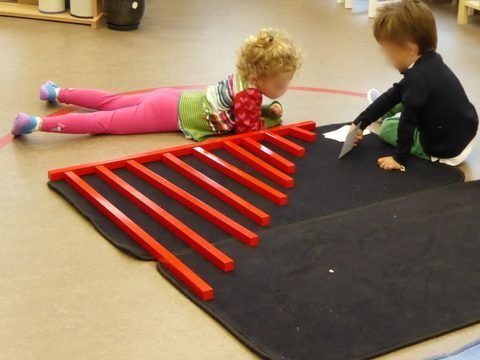
10 wooden rods differing in 1 dimension (length), ranging from 10cm to 1m.
Visual discrimination of differences in one dimension (length).
Preparation for Mathematics.


Building a maze or path.
Creating intricate radiating patterns from a central point.
Laying rods horizontally (exploring perspective).
Combining with Number Rods to compare length.


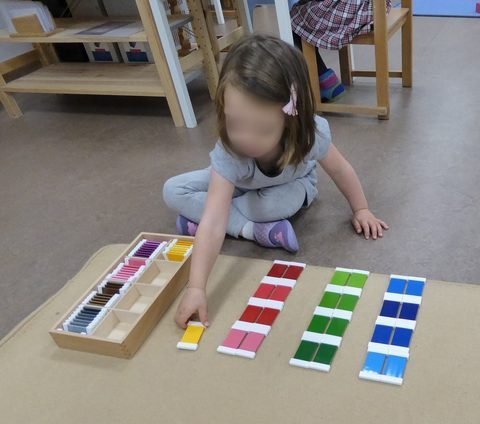
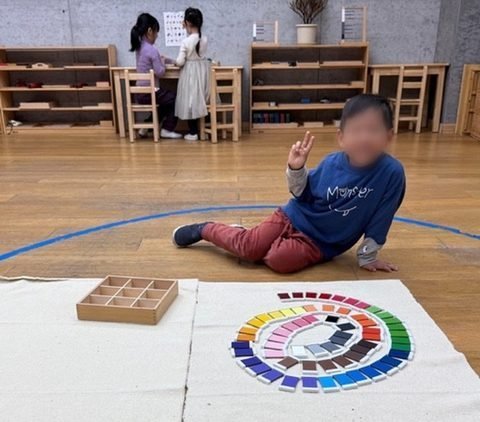
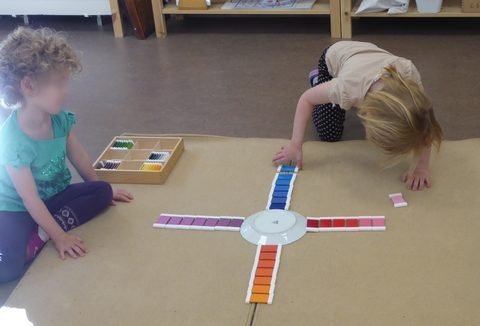
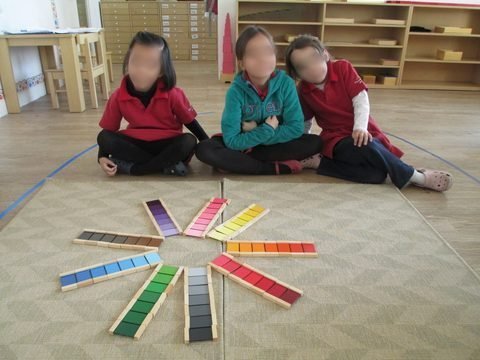
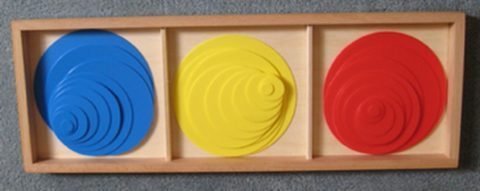
Colour Tablets
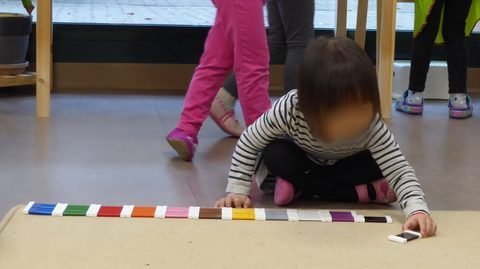
Box 1 - One pair of the three primary colours: red, blue, yellow.
Box 2 - One pair each of: red, blue, yellow, green, orange, purple, pink, brown, grey, black and white.
Box 3 - Nine colours, each presenting seven gradations of each of the colours: red, blue, yellow, green, orange, purple, pink, brown, grey.



Refinement of the chromatic sense, key to the world of colour.
Preparation for Art.
Creating complex gradients beyond the standard line e.g. circles or spirals.
Creating symmetrical or mosaic patterns.
Colour hunting - matching tablets to objects in the environment.
Mixing paints to match the tablets (bridge to art).



Geometry Cabinet
A wooden cabinet with six drawers containing 33 geometric insets with knobs in wooden frames with the bottoms of the drawers painted the same colour as the insets.
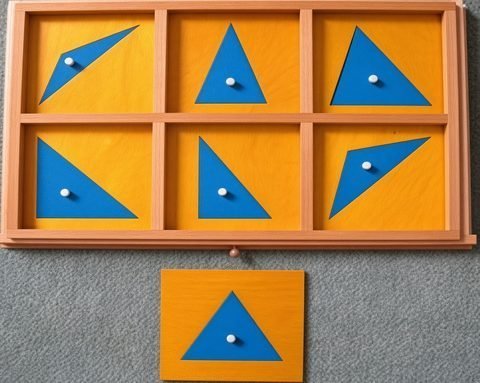
Equilateral, acute-angled isosceles, right-angled isosceles, obtuse-angled isosceles, acute-angled scalene, right-angled scalene, obtuse-angled scalene.
A square and 5 rectangles, the bases vary from 10cm to 5cm while the height remains constant.

Pentagon, hexagon, heptagon, octagon, nonagon, decagon.

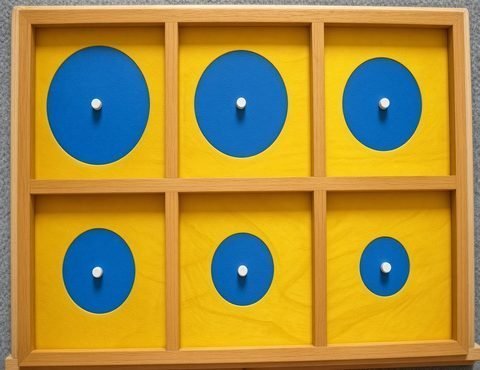
6 circles decreasing in diameter from 10cm to 5cm.
Curvilinear triangle, quatrefoil, oval, ellipse.

Rhombus, parallelogram, isosceles trapezium, right-angled trapezium.

On top of the cabinet is a demonstration tray with a removable grid top, and six blank wooden squares.


Three series of cards that correspond to the insets:
- Figure filled in.
- Figure with thick outline.
- Figure with thin outline.


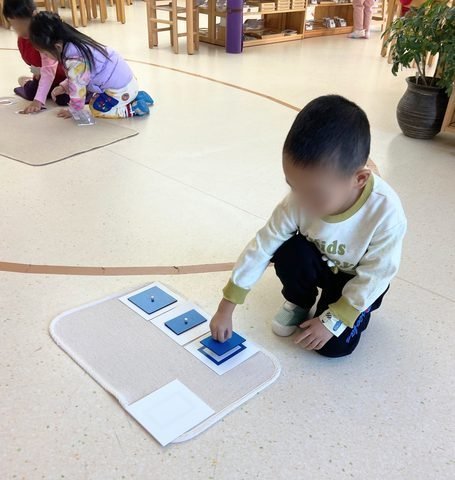

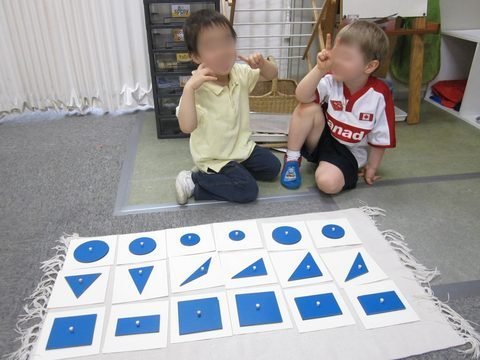

Visual discrimination of geometric shapes.
Preparation for Mathematics (geometry).
Preparation for writing
Creating complex designs by combining shapes from multiple drawers.
Tracing shapes and then filling them in with patterns or colours.
Matching shapes to objects in the environment or pictures.
Sorting cards by multiple properties e.g. all blue triangles, all large circles, etc.


Decanomial Square
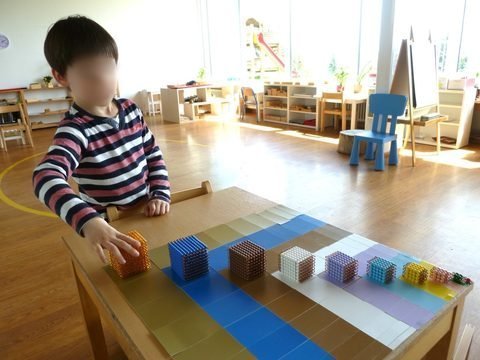
10 squares increasing in size from 1cm, each a different colour, with corresponding rectangles in the same colour (except the smallest square which has no rectangles).
Building the Square.
Refinement of visual discrimination.
Preparation for Mathematics.



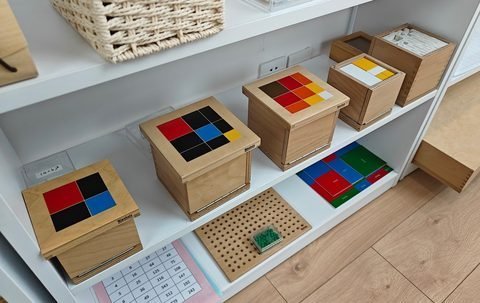
Binomial Cube
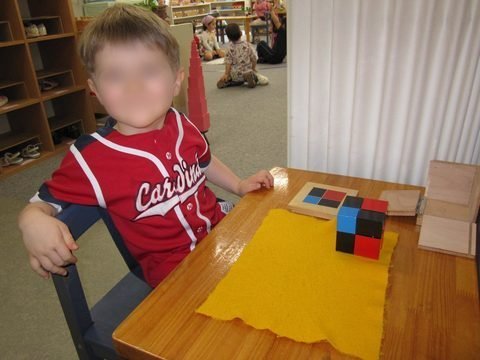
One red cube and three red and black matching prisms, one blue cube and three blue and black matching prisms - all the pieces once assembled form the binomial cube (a + b)3.
A binomial square in matching colours is painted on the lid of the box.
Build the cube.
Refinement of visual discrimination.
Preparation for Mathematics.
Deconstructing and reconstructing from memory without the lid pattern.
Building the cube outside the box.
Discussing the algebraic patterns visually represented (for Elementary children).


Trinomial Cube
One red cube and three red and black matching prisms, one blue cube and three blue and black matching prisms, one yellow cube and three yellow and black matching prisms, three of each remaining two-colour prism and six black prisms; all the pieces once assembled form the Trinomial Cube (a + b + c)3.
A trinomial square -in matching colours- is painted on the lid of the box.
Build the cube.
Refinement of visual discrimination.
Preparation for Mathematics.
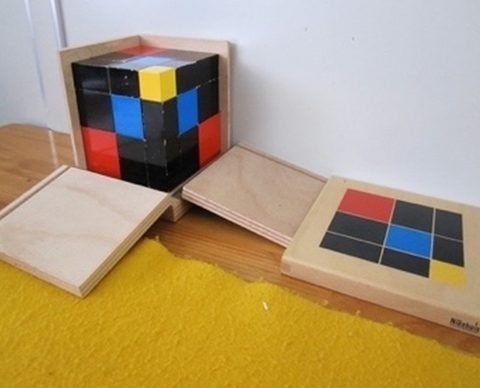
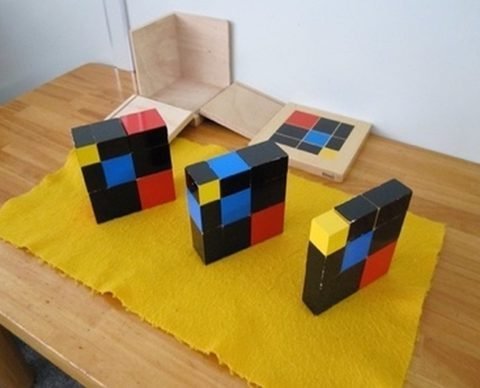


Deconstructing and reconstructing from memory without the lid pattern.
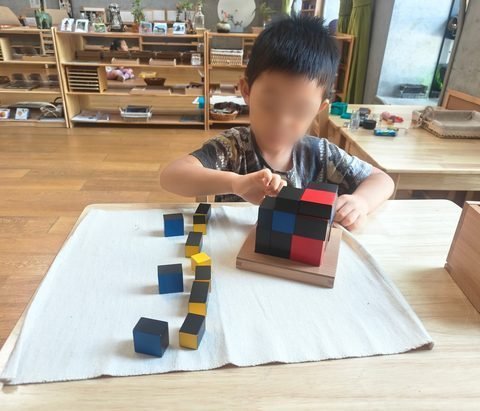
Building the cube outside the box.
Discussing the algebraic patterns visually represented (for Elementary children).



| a | + b | + c | ||||||||
| × | a | + b | + c | |||||||
| a2 | + ab | + ac | ||||||||
| + ab | + b2 | + bc | ||||||||
| + ac | + bc | + c2 | ||||||||
| a2 | + 2ab | + 2ac | + b2 | + 2bc | + c2 | |||||
| × | a | + b | + c | |||||||
| a3 | + 2a2b | + 2a2c | + ab2 | + 2abc | + ac2 | |||||
| + a2b | + 2ab2 | + 2abc | + b3 | + 2b2c | + bc2 | |||||
| + a2c | + 2abc | + 2ac2 | + b2c | + 2bc2 | + c3 | |||||
| a3 | + 3a2b | + 3a2c | + 3ab2 | + 6abc | + 3ac2 | + b3 | + 3b2c | + 3bc2 | + c3 |

The Montessori Commons website categorise The Binomial Cube, Trinomial Cube and Decanomial Square as "Algebraic Materials."
Constructive Triangles
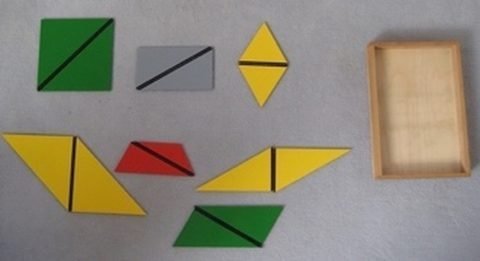
A pair of yellow equilateral triangles, each with a black line along one side.
A pair of yellow right-angled isosceles triangles, each with a black line along one of the sides enclosing the right angle.
A pair of green right-angled isosceles triangles each with a black line along the hypotenuse.
A pair of yellow right-angled scalene triangles each with a black line along the shortest side.
A pair of green right-angled scalene triangles each with a black line along the longer side enclosing the right angle.
A pair of grey right-angled scalene triangles each with a black line along the hypotenuse.
A pair of red right-angled scalene triangle, with a black line along the side opposite the obtuse angle.


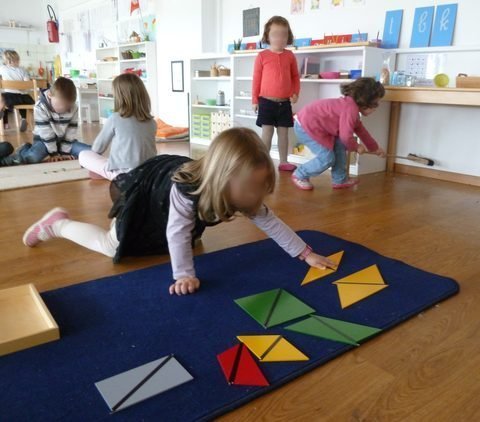
All without any black lines.
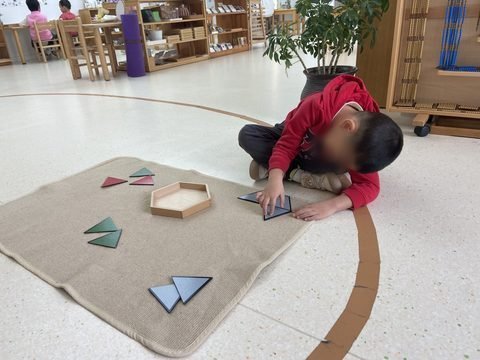
A pair of equilateral triangles.
A pair of right-angled isosceles triangles.
A pair of right-angled scalene triangles.
A small right-angled scalene triangle.
An obtuse-angled scalene triangle.
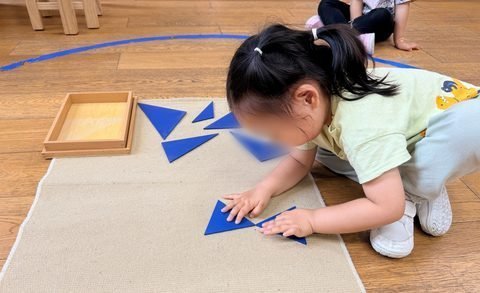
One large grey equilateral triangle without black lines.
Two green right-angled scalene triangles, each a half of the grey triangle, with black lines along the longer of the two sides enclosing the right angle.
Three yellow obtuse-angled isosceles triangles, each a third of the grey triangle, with black lines along both sides enclosing the obtuse angle.
Four small red equilateral triangles, each a quarter of the grey triangle, one with black lines along all edges, three with black lines along one side.


One large yellow equilateral triangle with black lines along all edges.
A pair of red obtuse-angled isosceles triangles, each with a black line along the side opposite the obtuse angle.
A pair of grey obtuse-angled isosceles triangles, each with a black line along one of the sides enclosing the obtuse angle.
Three yellow obtuse-angled isosceles triangles, each with a black line on the side opposite the obtuse angle.
Three yellow obtuse-angled isosceles triangles, each with black lines on both equal sides.

2 red equilateral triangles, each with a black line along one side.
1 green equilateral triangle, with black lines along two sides.
2 green equilateral triangles, each with a black line along one side.
6 grey equilateral triangles, with black lines along two sides.

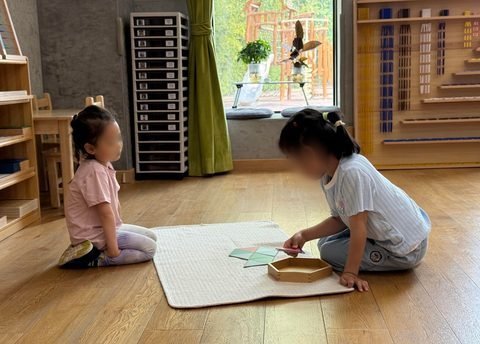
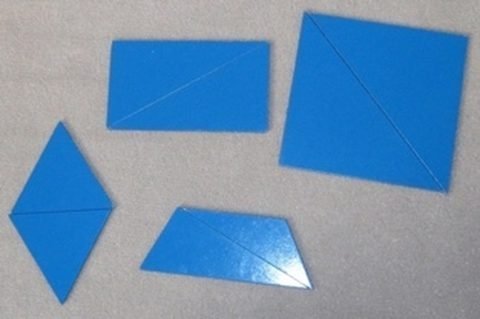
12 blue right-angled isosceles triangles.
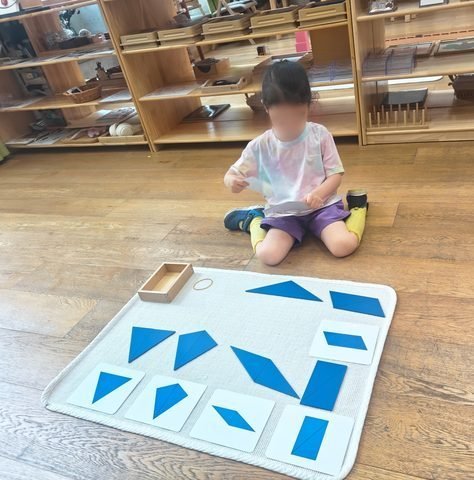
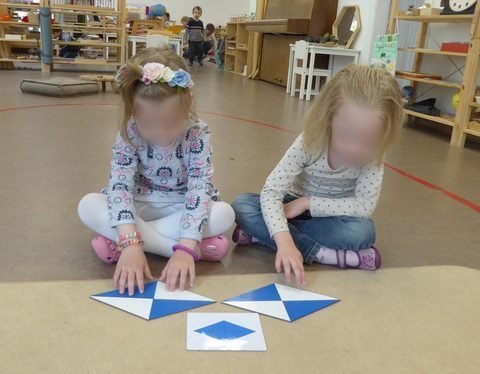
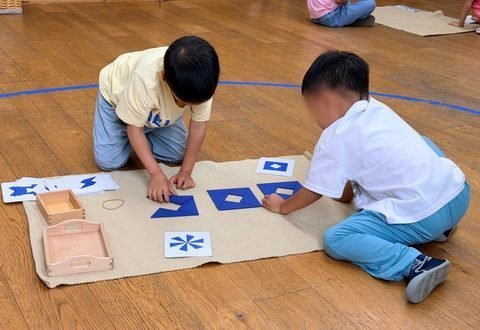

Exploration of the constructive power of the triangle.
Discovery that all straight-sided figures are formed by joining different triangles together.
Introducing similarities, equivalences and area of plane figures and congruencies.
Creating entirely new, complex shapes not shown on the presentation trays.
Building symmetrical designs or patterns.
Combining sets e.g., Rectangular Box + Triangular Box.
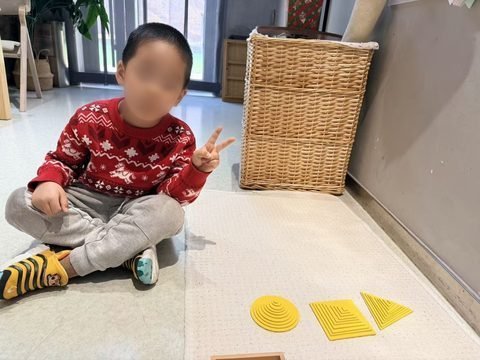
Graded Figures
Three sets of ten equilateral triangles with sides ranging from 1cm to 10cm, each set a different colour.

Three sets of ten squares with sides ranging from 1cm to 10cm, each set a different colour.

Three sets of ten circles with diameters ranging from 1cm to 10cm, each set a different colour.
Further exploration of plane figures.
Preparation for Mathematics.


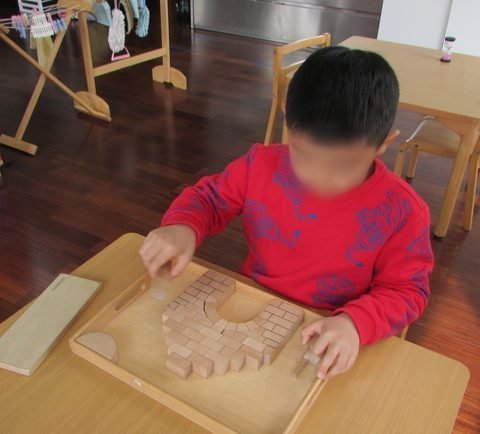
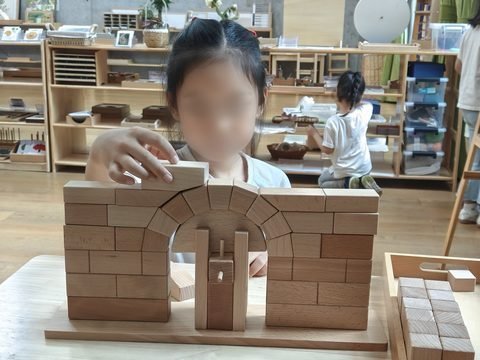
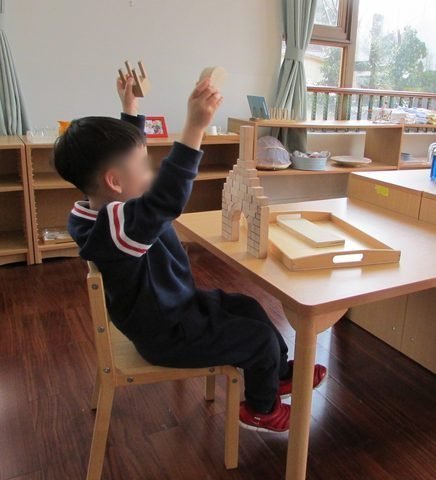
The Roman Arch
35 assorted wooden pieces and a three-piece arch support One solid wooden base which forms part of the wall.
Build the arch.
Preparation for Mathematics.



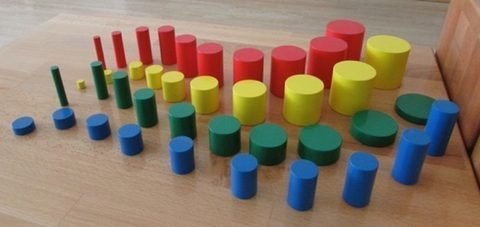
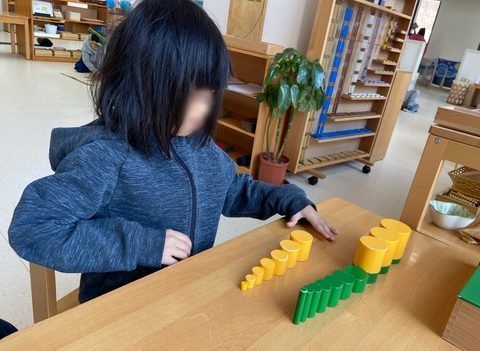
Knobless Cylinders
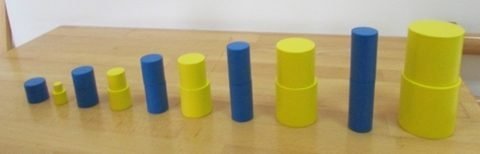
Four sets of ten cylinders, each set of the same dimensions as the four Cylinder Blocks, in red, yellow, green and blue.

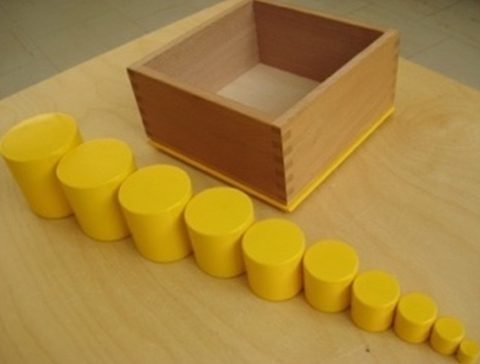

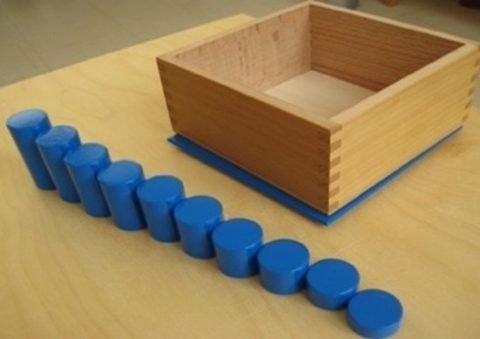
Observation and comparison of the different series with each other.
Understanding of dimensions and their interplay.



The Tactile Sense
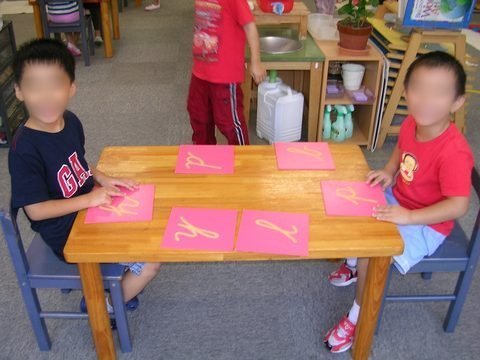
Touch Boards
Touch Tablets
Fabrics
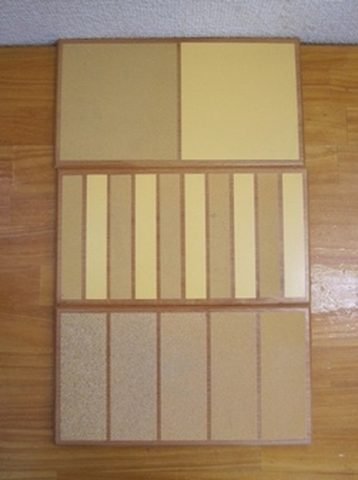
Touch Boards
Board 1: A rectangular board divided into 2 sections, one half rough, the other smooth.
Board 2: A rectangular board divided into 10 sections, alternately rough and smooth.
Board 3: A rectangular board divided into 5 sections of graded degrees of roughness.
Board 4: A rectangular board divided into 5 sections of graded degrees of smoothness.
A blindfold.
Sensitising Tray.
Refinement of the tactile sense.
Development of muscular control through lightness of touch.
Preparation for writing.

Touch Tablets
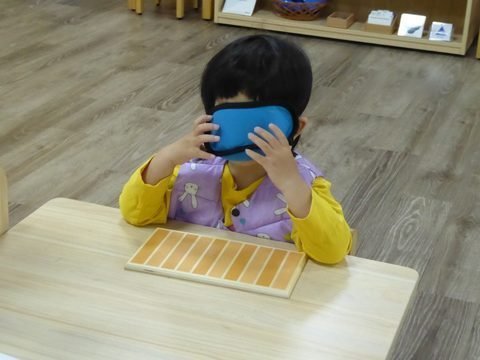
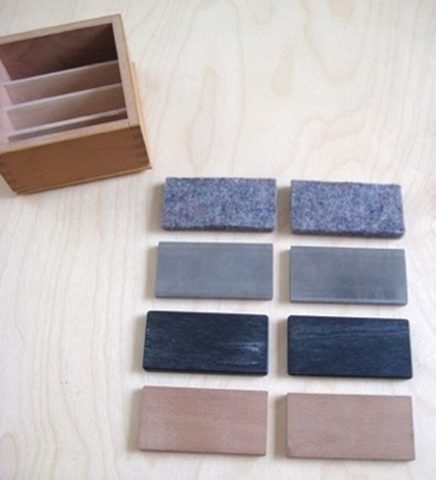
Five pairs of tablets of graded degrees of roughness.
Five pairs of tablets of graded degrees of smoothness.
A blindfold.
Sensitising tray.
Refinement of the Tactile Sense.
Preparation for writing.
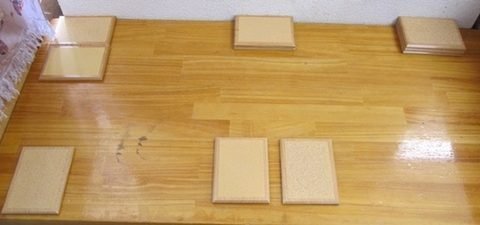
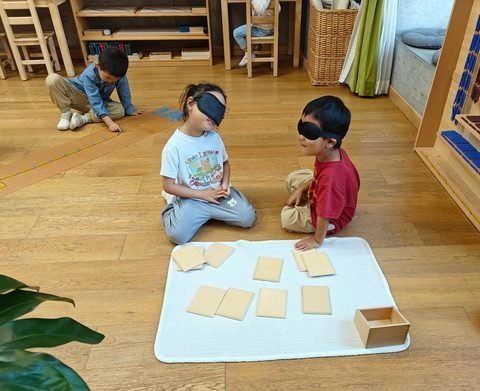
Grading textures from smoothest to roughest blindfolded.
'Texture scavenger hunts' in the classroom.
Fabrics
Box 1: 8 to 10 pairs of fabrics cut into identical squares, with edges serrated, each pair contrasting in texture and colour.
Box 2: 8 to 10 pairs of fabrics cut into identical squares, with edges serrated, each pair more similar in texture and colour.
A blindfold.
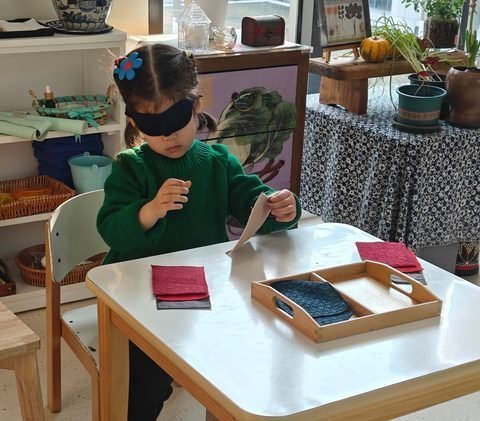
Further refinement of the tactile sense.
Complex Senses
Baric Tablets
Thermic Bottles
Thermic Tablets
Baric Tablets
Set 1: 7 light brown wooden tablets each weighing 20 grams.
Set 2: 7 light brown wooden tablets each weighing 30 grams.
Set 3: 7 light brown wooden tablets each weighing 40 grams.
Blindfold
Refinement of the baric sense.
Matching all three sets.
Weighing the tablets.


Thermic Bottles
Four pairs of metal bottles containing water of various temperatures:
- One pair at 47oC.
- One pair at 37oC - one of these is marked with a pink dot on top.
- One pair at 27oC.
- One pair at 17oC.
Cloth covers for each bottle to maintain the temperature.
Refinement of the thermic sense.
Thermic Tablets
Six pairs of tablets of substances differing in their heat-conducting properties.
A blindfold.
Further refinement of the thermic sense.


Stereognostic Sense
Geometric Solids
Stereognostic Bags
Stereognostic Trays
Mystery Bag
Dimensional Material
Geometric Solids
10 blue solids - cylinder, cube, ellipsoid, cone, sphere, square pyramid, triangular pyramid, ovoid, square cuboid, triangular prism.
Cards with each of the following geometric figures drawn with a thin blue line: square, rectangle, equilateral triangle, acute-angled isosceles triangle, circle, oval and ellipse.
A basket and cloth.
Refinement of the Stereognostic sense.
Awareness of solid shapes.
Preparation for Mathematics.

Sorting solids by whether they roll, slide, or stack.
Matching solids to their corresponding 2D bases from the Geometric Cabinet.
Mystery Bag games with more solids or combined with other shapes.


Stereognostic Bags
Wooden cubes and square cuboids (10-12 of each).
Three groups of small objects (4-5 of each) contrasting in three aspects (shape, size and texture).
Three groups of small objects (4-5 of each) contrasting in any two aspects.
Three groups of small objects (4-5 of each) contrasting in any one aspect.
A blindfold.
Refinement of the Stereognostic sense.



Stereognostic Trays
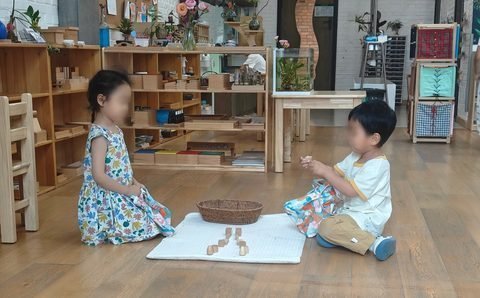
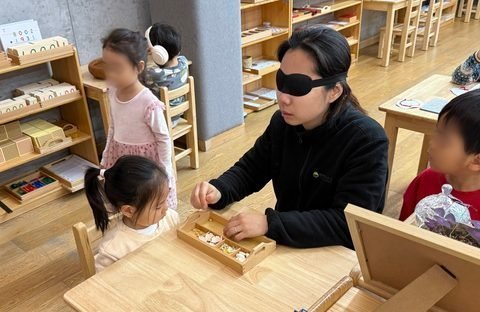
A large dish and three smaller dishes in each of the trays.
Three different groups of small objects (6 or 7 of each), sorted into the smaller dishes
Three different groups of finer objects (6 or 7 of each), sorted into the smaller dishes.
A blindfold.



Mystery Bag
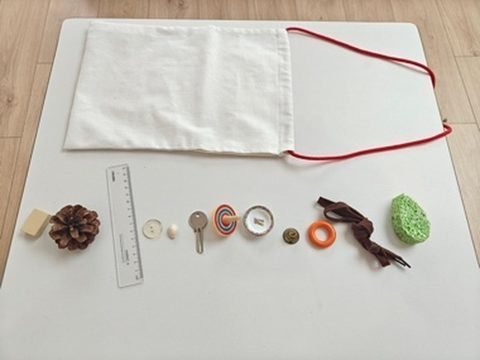
A bag containing 12 familiar objects that fit into a child's hand.
Refinement of the Stereognostic sense.
Mental visualisation.


The Olfactory Sense
Smelling Bottles (or Smelling Jars)
Smelling Bottles
Three pairs of smelling bottles, each set a different colour, each pair containing various substances with different odours: perfume, medicinal, culinary, etc.
Other possible subsets
Three pairs of perfumes, three pairs of culinary odours, or three pairs of medicinal odours.
Three pairs of smelling boxes, each pair containing various dry substances with distinct odours.
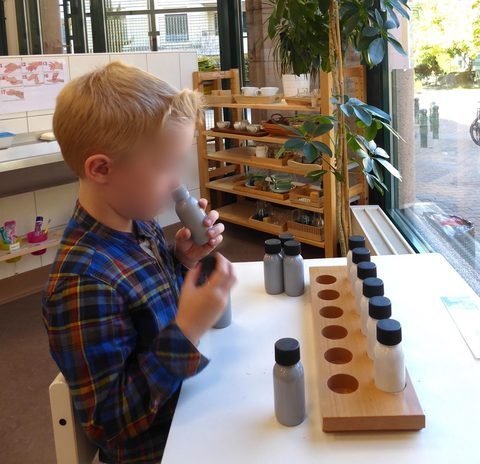

Refinement of the olfactory sense.
The Gustatory Sense
Tasting Jars
Tasting Jars
Eight jars with dropper lids, made of dark glass:
2 containing salty water
2 containing water sweetened with sugar
2 containing water made bitter with coffee
2 containing water made acidic with vinegar

Refinement of the Gustatory sense.
Developing an awareness of the connection between taste and smell.
The Auditory Sense
Sound Boxes
The Bells
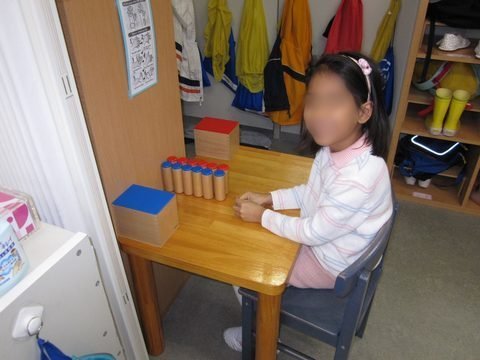
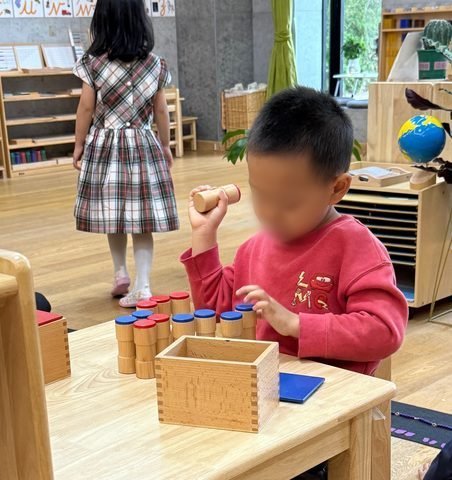
Sound Boxes
Six pairs of sound cylinders, each set in a different colour, which make a different sound when shaken, ranging from loud to soft.
Refinement of the auditory sense.
Grading the cylinders from loudest to softest.
Creating simple rhythmic patterns.
Matching sounds to environmental sounds.

The Bells
Eight pairs of bells of the major scale beginning on middle C [do].
The stands of one set are white and the other set naturally varnished.
Two colour-coded boards (representing the piano keyboard) upon which the bells are arranged in order.
A mallet and a damper.
Auditory discrimination of sound.
Preparation for Music.
Grading the bells.
Grading the bells as a group (requires 8 children).


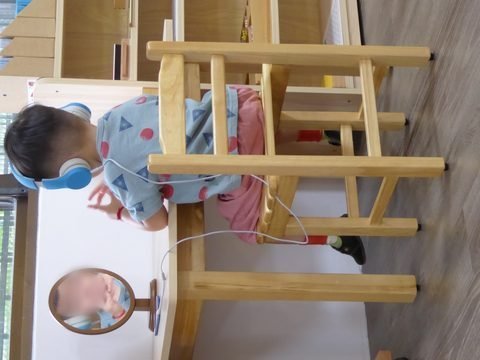
Music - Headphones
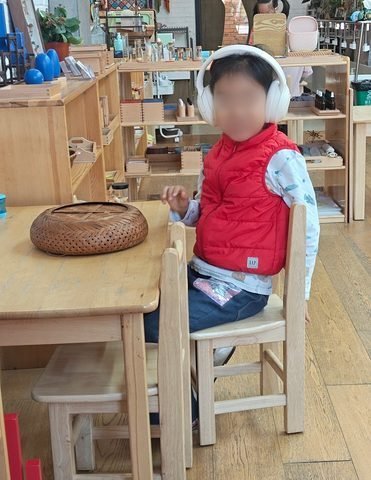
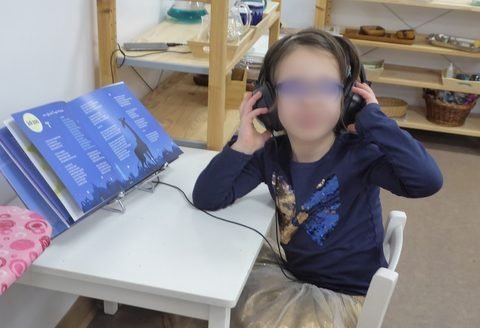
They're not part of the AMI Sensorial curriculum, but children love putting on headphones and listening to music or audiobooks, and I've found it to be a passive but effortless but nevertheless effective way to reinforce any song I want them to learn, for example when I'm rehearsing for the end of term or end of year performance, or if Christmas or any other significant holiday is approaching.



The Spiral Curriculum
The Spiral Curriculum is an instructional approach where key concepts, topics, or skills are revisited multiple times throughout a learner's education, with each iteration increasing in complexity and depth. Examples include:
The Binomial Cube, the Trinomial Cube, the Arithmetic Trinomial Cube, the Powers of Two Cube, and the Volume Box with 1000 Cubes.
In a 3-6 class, a child uses their sense of touch in the following order: