Theory and Materials

Montessori Helper
Have an online course of Sensorial activities, and their Introduction to Sensorial includes a 30-minute video of Margaret Homfray discussing the Knobbed Cylinders.
Chloë Marshall
“The Montessori educational method has existed for over 100 years, but evaluations of its effectiveness are scarce. This review paper has three aims, namely to (1) identify some key elements of the method, (2) review existing evaluations of Montessori education, and (3) review studies that do not explicitly evaluate Montessori education but which evaluate the key elements identified in (1).”


Lynne Lawrence
Lynne Lawrence is the Executive Director of AMI.
Montessori AMI 3 to 6
Greene Towne Montessori
Includes many photos of children using the Sensorial materials.
Sensorial at Home
Montessori Family
Includes useful advice on ‘How to Bring Montessori Sensorial Learning into the Home’.
The Little List
“Make your own Montessori sensorial materials with these tutorials and free printables.”
A collection of useful links to different websites.
The Global Montessori Network
Includes a list of pairing activities that can be easily set up at home.
“Incorporating sensorial work into your home can be done by creating an environment well-prepared where children can explore, learn, and understand their world through the five senses.”

Sensorial Albums
Books
Below is a brief overview of how Montessori’s thinking on Sensorial education developed steadily across her major works, moving from detailed practical description to deeper psychological framing.
Abridged and annotated by Gerald Lee GutekPDFUnabridgedPDF
In her first book, Montessori -drawing on the earlier work of Itard and Séguin- explained the principles of isolating a single quality (colour, dimension, texture, sound, weight, temperature), arranging objects in graduated series, building in control of error, and using the materials to refine perception and prepare the intellect. This remains the foundational technical account of the Montessori materials and their exercises.
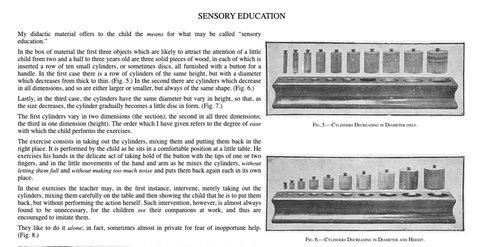
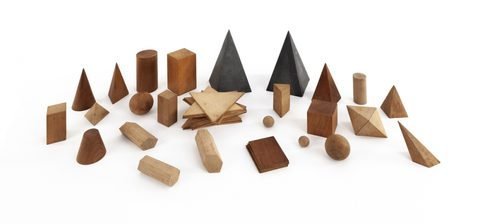
Contains a more concise, practical guide to the sensorial apparatus, briefly describing the main materials -Cylinder Blocks, Pink Tower, Colour Tablets, Sound Boxes, Geometric Solids, and others- without the extensive theoretical discussion of the earlier book and practical focus resulted in the handbook being used as a working manual for teachers.PDFPDF
Montessori extended the discussion beyond the early childhood years: the first volume focuses on spontaneous activity, attention, will, and intelligence and the second volume presents the elementary materials. Sensorial foundations continue to underpin the later work, which includes her thoughts on the refined discrimination of form, dimension, and how colour supports geometry, arithmetic, and grammar. Advanced materials such as the Binomial and Trinomial Cubes and Constructive Triangles are treated as natural extensions of the earlier sensorial exercises, showing how concrete sensory experience prepares the mind for abstraction.
“The sensory education which prepares for the accurate perception of all the differential details in the qualities of things, is therefore the foundation of the observation of things and of phenomena which present themselves to our sense; and with this it helps us to collect from the external world the material for imagination.”
- The Advanced Montessori Method, Volume I, p. 191.
This work shifted the emphasis from materials themselves to the inner developmental processes they serve. Montessori linked sensorial refinement to the sensitive periods, in particular the sensitive period for the refinement of the senses (ages 2-6). The materials are presented as responses to the child’s intense need to classify and order sensory impressions. She stressed that without this ordered sensory foundation, the child’s intelligence remains chaotic and clarified that the adult’s role is to prepare an environment that allows the child’s spontaneous exploration.
This work contains the most comprehensive psychological framework for the sensorial materials, which are portrayed as keys that help the absorbent mind organise the flood of impressions received from the environment. Montessori emphasised that the child from birth to six constructs their inner order through repeated, self-directed activity with concrete materials, and that this sensorial grounding is the indispensable basis for all later intellectual and cultural learning.
Forty years after she wrote The Montessori Method, Montessori published this thoroughly revised and expanded edition. The sections on the Sensorial apparatus are framed less as experimental stimuli and more as aids that enable the child to impose order on sensory chaos, develop concentration, and construct intelligence through free, repeated activity and the core principles of isolation, gradation, control of error, and limited quantity are restated with the benefit of decades of observation.
“The training and sharpening of the senses has the obvious advantage of enlarging the field of perception and of offering an ever more solid foundation for intellectual growth. The intellect builds up its store of practical ideas through contact with, and exploration of its environment. Without such concepts the intellect would lack precision and inspiration in its abstract operations.”
Across all of these books Montessori’s core principles remained consistent: isolation of qualities, mathematical gradation, control of error, aesthetic appeal, and limited quantity. What changed was the framing: In her early writings Montessori largely focused on the scientific design and practical use of the materials, while in her later writings she integrated them more fully into a comprehensive vision of the child’s natural development.