Introduction
Parents trust us with their children, and we have a responsibility to live up to that trust and a responsibility to ensure that the child achieves their potential: socially, emotionally, linguistically, physically and intellectually. This latter aspect, the academic development aspect, is frequently emphasised too much by parents and not enough by teachers. Friends of mine -parents with children in Montessori classrooms- have told me how they’ve asked the teacher for an explanation of how their child is progressing in language or mathematics and been told that, “every child is different” but to trust the teacher because they “follow the child.”
Non-responses such as these leave many parents feeling justifiably frustrated and although they tell you nothing about the child, they tell you quite a bit about the guide - either they know where the child is in each area of their development and are unwilling to tell the parents, or they don’t know where the child is in each area of their development. I’m not sure which of these is worse, because in a Montessori 3-6 classroom, they should be aware of and following a scope and sequence, which means knowing which materials and skills children need to master and understanding the natural order in which those lessons are given, while still allowing each child to progress individually. In simple terms, a scope and sequence is a document or a plan that outlines what we should teach (the scope) and when we should teach it (the sequence) and serves as a roadmap for a specific subject area over a specific timeframe.
How It Works in a Traditional Classroom
It dictates what every child in a specific grade must learn during that academic year.
The timeline is fixed so the teacher must follow the sequence, introducing new topics according to a set schedule, regardless of whether every student has mastered the previous one.
All children in the same grade are expected to be working on the same concepts at the same time.
How it works in a Montessori classroom
It outlines the full pathway of learning from 3 to 6 (or 6 to 9, or 9 to 12) whilst allowing for the fact that children develop at their own pace.
The Montessori guide should use it as a roadmap to give individual and small-group lessons to each child when they are developmentally ready and show interest. Nevertheless, there still needs to be a …
Irrespective of their interest, curiosity and motivation, there are certain cultural and/or legal expectations for each child, for example physical ones like being able to walk on a line or grip a pencil correctly, or academic ones such as recognising letters and numbers, etc. These might be detailed by week, month, term or by year, and accumulate over the course of a three-year cycle.
The sequence is designed as a spiral whereby a concept is introduced simply in the Primary (3 to 6) environment and revisited in more detail in Elementary (6 to 9, and 9 to 12) classrooms. In Geography, for example, a child might be introduced to different cultures in this sequence of presentations:
AgePresentation
3Land + Water Globe
3 ½Continents Globe
4Puzzle Map of the World
4 ½Puzzle Maps of individual continents or countries
5 - 6People/food/animals/buildings/music of a continent or a country
6 - 12History and political systems of a continent or a country
The ScopeWhat to teach?
The scope refers to the depth and breadth of the content to be covered, which is a Montessori class means all of the materials in the Prepared Environment:
Practical LifeFine and gross motor skills, care of self, and care of the environment e.g., pouring, polishing, buttoning, etc.
SensorialRefining the five senses to categorize the world e.g., the Pink Tower for dimensions, the Colour Tablets for chromatic sense.
LanguageProgressing from spoken language to phonetics, and from writing to reading.
MathematicsIntroducing the decimal system through concrete, manipulative materials.
CultureGeography, Botany, Zoology, Art, Science and Music and Movement.
The scope also encompasses the topics, skills and standards a child is expected to attain.
TopicsThemes or concepts e.g., Fractions, Capitals of Asia, Numbers from 0 to 9.
SkillsSpecific abilities e.g., holding a pencil, completing a puzzle, conducting a science experiment.
StandardsThe learning goals or benchmarks that children are expected to meet. In traditional education these are often aligned with state or national standards, and in AMI Montessori they are set by the AMI Scientific Pedagogy Group.
The SequenceIn what order and when to teach it?
This is the logical, step-by-step progression of the content and skills.
Philosophical BasisMaterials are presented from known to unknown, from the whole to the part, from concrete to abstract and from simple to complex.
PacingHow much time might be spent on each topic e.g., three weeks for Sandpaper Letters or one year for the first four stages of the Sound Game.
Logical ProgressionSkills are organised to build upon one another, for example addition is taught before multiplication and the Pink Tower before the Brown Stairs.
A typical language sequence might look like this:
- Vocabulary enrichment and Sound Games
- Letter sounds using Sandpaper Letters
- Word building with the Moveable Alphabet
- Phonetic reading with Object Boxes
- Reading books and writing sentences
Indirect Preparation
Motor coordination precedes intellectual abstraction, with many materials and exercises preparing children for mathematics, reading, and scientific thinking. See my Introduction to Mathematics for more on this topic.
| Quality developed | Material | Preparation for |
|---|---|---|
| Classification | Pink Tower | Volume, Cube geometry |
| Comparison | Brown Stairs | Width and dimension |
| Pattern recognition | Geometric Cabinet | Geometry vocabulary |
| Dimensional awareness | Colour Tablets | Visual discrimination used in science |
Follow the Child
Some Montessorians find it difficult to reconcile their obligation to use a Scope and Sequence with the seemingly contradictory imperative of following the child’s interests, but as Maria Montessori remarked, "Follow the child, but follow the child as his leader." Each child is on a learning journey, and the Scope and Sequence provides the roadmap, while the child’s natural development and interest provide the engine, so a lesson plan needs to be viewed less as a rigid calendar of dates for when the child must learn a specific skill and more like an inventory of the materials and lessons available in the classroom. The guide needs to have a deep understanding of the skills (the scope) the child needs to acquire and in what order (sequence) concepts build upon one another (e.g., from concrete to abstract) and we develop this awareness through an ongoing process of observing the child’s readiness (are they physically and cognitively ready for the next step in the sequence?) and interest (are they drawn to a certain area, material of presentation?).
Freedom Within Limits
This is an important principle in Montessori education and key to understanding the apparently contradictory mandates of following the child and following the Scope + Sequence: the Scope and Sequence defines the limits or the essential skills and knowledge the child needs to acquire, while ‘Follow the Child’ defines the freedom or the choice of when and how to engage with the materials.
Freedom - The child chooses the material, the duration of the activity, and the amount of repetition.
Limits - The child is expected to master certain (but not all*) elements of the curriculum to ensure a well-rounded education.
Individualised instruction greatly aids with this process: the child progresses through the sequence at their own speed -moving quickly through mathematics if they are drawn to it but taking more time with language if they find it difficult or less interesting.
* Not every child will receive every presentation. Sometimes the child will have already mastered a concept and won’t need a lesson and sometimes they join a classroom late and won’t have time to cover everything. There is flexibility within the curriculum that allows for this.
The Role of the Adult
The guide acts as a dynamic link between the child and the materials. If a child is stalled, the teacher doesn't remain passive, they try to entice the child toward the next step in the sequence, providing scaffolded instruction. If a child only does art but needs to work on fine motor skills for writing (the next step in the sequence), a guide might introduce a specific art technique that requires the same pincer grip used for holding a pencil. In this way, learning is child-led but teacher-guided.
Why use a Scope and Sequence
Even though Montessori classrooms are child-directed, teachers still rely on a scope and sequence to:
- Ensure complete coverage of Montessori materials
- Track individual student progress
- Maintain developmental order of lessons
- Support curriculum documentation
By having a rigorous scope and sequence, the guide is freed from the burden of what to teach and can focus entirely on when the child is ready. Structure provides the safety that makes true freedom possible.
How to create a Montessori Scope and Sequence
Benchmarks are specific, measurable checkpoints or standards of expected at certain levels or times, used to assess learning, progress, and achievement. They help schools, teachers and parents understand whether children are meeting certain expectations or learning goals at specific stages of their education, and serve as vital indicators for teachers to identify learning gaps and adjust instruction. Many Montessorians will tell you that there are no benchmarks in the Montessori approach -because every child is different!- just as they will try and convince you that there is no Montessori curriculum but there most certainly is a curriculum and there most certainly are benchmarks.
On a Montessori teacher-training course, the majority of time is taken up with creating albums of presentations in the five areas of the class: Practical Life, Sensorial, Culture, Language and Mathematics. This list of presentations is the curriculum (or part of it). Each presentation follows the same template, using the same set of categories:
TitleIndirect AimControl of Error
MaterialsPresentationLanguage
Direct AimExercisesAge
‘Age’ refers to the average age at which a normal child -without any kind of developmental delay, in a classroom which uses their native language- would be expected to receive each unique presentation. These numbers aren’t discussed during the training -as the Montessori curriculum isn’t discussed- but each of them is a unique and specific benchmark and so if you were to create a table or a chart (the standard way a Scope + Sequence is displayed) containing the AMI-recommended date when every individual piece of material in every area should be presented, you would have something very closely approximating to the entire scope and sequence for the 3-year Montessori cycle. Which is what I did…
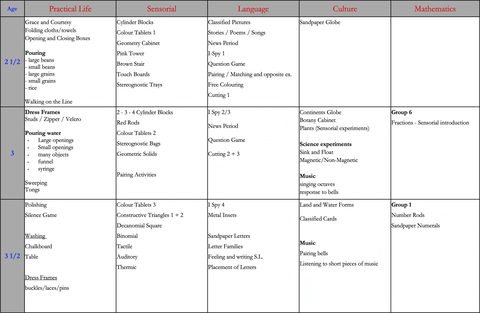
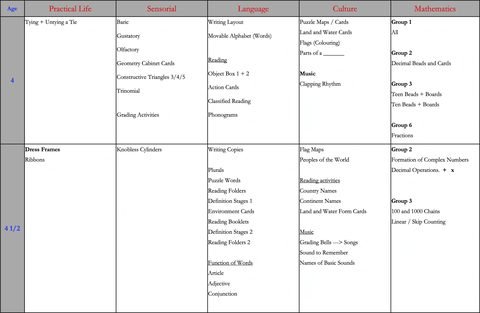
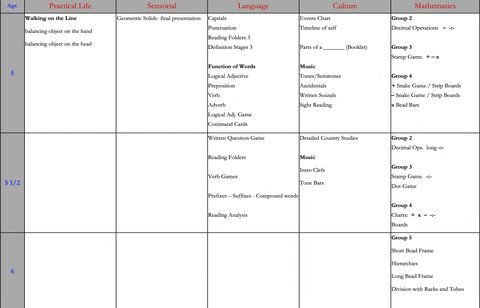

There are many alternative -and prettier- versions of this Scope + Sequence, ranging from very simple to very complex ones such as the Montessori Foundation Curriculum Guide/Scope + Sequence for ages 0 to 12. It is 279 pages long, and their 3 to 6 curriculum is 90 pages. See the Resources page for more on this and other examples.
| Curriculum Area | Early Presentations (Age ~3) | Developing Work (Age ~4) | Advanced Work (Age ~5-6) |
|---|---|---|---|
| Practical Life | Carrying trays, spooning, pouring water, opening/closing containers, hand washing | Dressing frames, food preparation, table washing, sweeping, plant care | Advanced food prep, sewing, polishing, care of environment leadership |
| Sensorial | Pink Tower, Brown Stair, knobbed cylinders | Red Rods, colour tablets, geometric solids | Sensorial extensions, grading exercises, pattern building, language for qualities |
| Language | Spoken language games, vocabulary cards, sound games | Sandpaper Letters, Moveable Alphabet | Phonetic reading, grammar symbols, sentence writing, early research |
| Mathematics | Number Rods, number recognition | Spindle Boxes, Golden Bead Material (place value) | Operations with golden beads, Stamp Game, Bead Chains |
| Cultural Studies | Nature exploration, globe, land/water forms | Continent maps, simple science experiments, plant studies | Animal classification, geography research, timeline concepts |
Why use a Scope and Sequence in Montessori?
A Scope and Sequence ensures:
- That Montessori teachers cover all required material and don't skip necessary foundational skills, preventing gaps or repetition.
- That the curriculum is coherent, rigorous, and aligned with educational standards.
- A logical, manageable progression of learning, preventing children from being either overwhelmed by material they aren't ready for or bored by material they have moved beyond.
In short, a scope and sequence ensures that learning is intentional, organised, and cumulative, so that children encounter all the key Montessori materials and concepts over the three-year cycle.