Introduction
There’s a great deal of work that needs to get done at the beginning of the year, particularly if you’re stablishing a new class, but for the sake of brevity - and because I’ve already written about how to prepare a new environment - my focus here will be on preparing an already established class at the end of the summer. Amongst the elements that need to be considered are:
- The prepared environment
- Administration - documentation
- Coordinating the team - the roles of the adults
- Lesson Planning
- Practicalities: Routines, Rules and Circle Time
- Social and emotional foundation
- Parent partnership and engagement
The Prepared Environment
If the class was closed up in an orderly and efficient manner (there are free tools to help with this, including ones provided by ‘Public Montessori in Action’ here and here) it greatly reduces the pain of that first week back at the end of the summer, but there’s still lots to prepare. These are some of the elements that I consider:
Classroom Flow Traffic patterns, table arrangements, and the layout of floor mats to avoid congestion.
Order and Aesthetics Placement of shelves, defined workspaces, visual balance, and minimising clutter.
Materials Readiness Inventory, repair, cleaning, and replenishing consumables (paper, glue, pencils).
Administration - documentation
There’s a wide variety of documentation that needs to get created or updated every year, including:

- Contact details for parents and caregivers.
- Allergy list.
- List of children’s birthdays a) in order of age and b) in calendar form.
- Birthday celebration document - review
- Children’s name-cards for - marking materials/
snack/ folders/ toothbrushes/ cups for water. - Individual checklists also have to be prepared for each of the new children.
Coordinating the team - the roles of the adults.
Irrespective whether the teaching team are established or contains new members, scheduling formal weekly meetings and daily debriefs is essential, but if there are new members of the teaching team it’s important to clarify roles and responsibilities in advance of the arrival of the children:
- Who’ll be managing the class?
This is the most difficult part of the job; whoever has the role is responsible for managing 20+ children - but also the most interesting, so I like to do it. It also allows me to interact with pretty much all of the children each day, and that’s important to me.
2. How to manage the class?
This is a complex and fascinating topic, one which I could write 10,000 words about, but if I had to choose the three key bits of advice, they would be:
- Guide the children,
- Anticipate issues and head them off,
- Less talk, more action.
- Who’ll be giving presentations?
Most classes have a second Montessori teacher, and I generally give them the easier job of presenting - focusing on one child at a time - so they can master all of the varied elements of presentations without having to stress about the class being in disarray.
- What are the assistant’s responsibilities?
The job of the assistant is to support the Lead Guide. Some assistants think their role is to support the children, but I feel it’s to do what the Lead Teacher asks/
needs and to make their life easier, an approach which greatly simplifies communication and avoids misunderstandings. This typically involves dealing with toilet-related issues, reinforcing the rules, re-presenting things like Rolling a Mat or placing trays back on the shelf in the right place and straight, neat and gently, walking in the class, washing hands after using the bathroom, etc.
- If there’s a cleaner in the room during the day, what are their responsibilities?
Cleaners should clean. That seems obvious, but in many non-normalised classes the cleaner has been co-opted as a second assistant, which might help to resolve minor issues from time to time, but which comes at high cost as the presence of a fourth educator greatly reduces the independence of the children.
Lesson Planning
Even if I work alongside a second Montessori Guide, I’ll often prepare the Lesson Plan at the beginning of the year, because I know the children best and because it’s simpler and quicker for me, so it reduces any pressure a new teacher might be feeling. As always when creating and following a Lesson Plan, there’s a balance to be struck between following the child and adhering to the scope and sequence or following a curriculum.
Returning children
The Lesson Plan that I used during the final week before the holidays is ideal to use again, particularly if I remembered to add notes on what each child was especially drawn to that week. I’ll also review each child’s checklist just to remind myself where they were and to make sure I haven’t inadvertendly missued something. Either way, it’s been my experience that when children return to the class at the end of the summer they are full of motivation and curiosity and seem like they’ve been starved for intelelctual stimulation for a couple of months, so they really don’t need any presentations that first week back. Which is ideal, as it means I can focus on the new 3-year-olds.
New children
There is a curriculum in place for each age group, so it’s possible to predict which materials, activities and exercises a group of 3-year-olds will be interested in, but not all presentations are created equal; those which necessitate minimal effort, but which engage the child for the longest amount of time are invaluable, so it’s helpful to have an idea of Preliminary Presentations. I present Botany and Zoology Puzzles right away, because:

- Many children are already familiar with the concept of puzzles.
- They are also likely familiar with the plants and animals used in the puzzles, and
- There are more than 10 of puzzles, but I only have to present one, after which I can invite the child to explore the others using the same steps, so one presentation opens up 10 different activities.
- Added bonus: as soon as the child has mastered the puzzles it only takes a moment to demonstrate how to make them outside the frame, and now you’ve set them off on 10 new and stimulating challenges.
Other high-value presentations
- Cylinder Blocks - one presentation for four Cylinder Blocks, followed by brief explanations of how to lay out 2 Cylinder Blocks together, and then 3 and then 4. That’s two months’ work right there.
- Colouring - familiar, stress-free, fun, and relaxing.
- Cutting and glueing - snippets are aimed at the sweet-spot for many 3-year-olds and combining them with a spot of glueing is the perfect extension.
Notes on Presentations
- They should be brief.
- They should be silent.
- Children are more physically controlled when sitting on a chair than sitting at a mat.
- A table in quiet corner facing a wall is better than one located in the middle of the room.
- Before, during and after a presentation, communicate with the other adults, even if it’s only by eye contact.
The Mixed-Age Dynamic
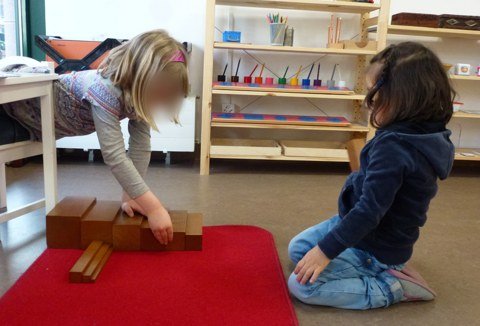
I’ve opened new classes with 8 to 10 children and reopened established classes with 30 children, and the latter is much much easier I had older children to guide the younger ones and demonstrate that their new class/
Practicalities: Routines, Rules and Circle Time.
Children crave order, routine and structure, and this is particularly true during the first few weeks in the class, when they are spending so much of their day in an environment that is new, strange and more than a little frightening or at the very least baffling. For this reason, it is essential to establish consistent, logical and safe routines from the very first morning, including the following:
- Arrival and dismissal procedures: systems for greeting, unpacking, and entering/
exiting the class/ school. - The work-cycle: choose an activity, engage with it, return it to the shelf, repeat.
- Materials on a mat/
table, adults and children on the floor/ in a chair. - How to use the bathroom, including washing hands.
- Snack routine: when, where, serving, how many children, how long, etc.
- Transitions: how to switch from Montessori time to circle time.
Freedom and Limits
It’s important to try and set the right tone from the very first day, balancing warmth with firm, consistent limits to establish safety. Rules, like routines, are crucial in a room inhabited with 20+ children with 20+ needs, desires and interests, so if fair, reasonable and consistent rules aren’t put in place from the first morning and rigorously enforced, you’ll waste a huge amount of time trying and failing to correct them over the course of the next three years. Defining clear limits that ensure respect for oneself, others and the environment while establishing logical consequences is essential; examples include:
- Put one thing away before playing with something else.
- Wash hands before meals and after using the bathroom.
- Walk, don’t run in the class.
- I clean my mess; you clean your mess.
- Ask your friends to help you.
- Slowly, gently.
Circle Time
When to have circle time?
Beginning or ending of Montessori time? In a perfect world all of the children would arrive within a narrow (10-15 minute) timeframe, but in many schools the timeframe can be more than an hour, so the most logical time to have a circle is at the end of the morning.
Must all children join?
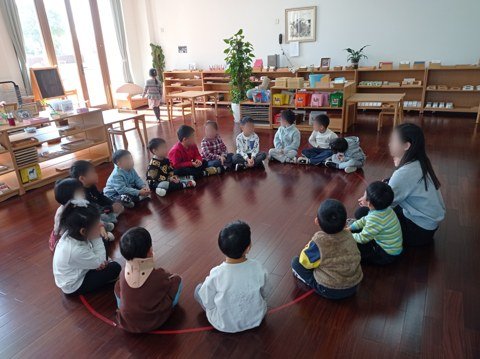
I can hardly believe that this is a serious discussion in the Montessori world, but for me: yes, of course they must. I’m as much into independence and freedom as the next Montessori guide but come on: we are social beings and with social rights come social responsibilities, one of the fundamental ones being the importance of accepting that subsuming the needs of the many sometimes outweigh the needs of the few, or the one. Go join your friends at Circle Time. It won’t emasculate you too much.
Another reason why they should join: if they don’t, who’s monitoring them? If it’s the Lead Guide, who’s running the Circle Time? If it isn’t, is the Lead Guide still responsible for any accidents that happen when they asked someone else to monitor the child/
Circle Time ideas
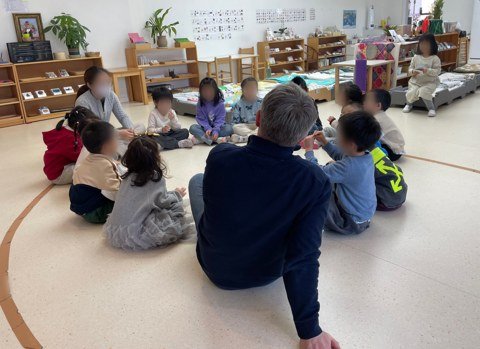
Perhaps it’s a question of temperament, but it seems to me that Circle Time is often when the Montessori class most closely resembles a traditional class, with everyone looking at the adult. I’ve worked alongside guides who loved nothing better than getting out that guitar at circle time and turning the focus on them, making the children sit through Imagine or Wonderwall or No Woman, No Cry. I aim for something different - a circle that closely resembles a bunch of friends having a dinner party, sharing anecdotes, telling jokes, singing (children’s) songs, chatting together, having fun, discussing whatever is of interest to them. I see my role as two-fold. Firstly, I guide the children in how to create a circle that is in fact an ellipse, as the children sit on the line:
- Hold hands, cross feet, drop hands, slowly sit.
- How to sit: leg crossed, upright.
- How to communicate: speaking and listening.
My second responsibility is to guide and direct things, ensuring that the children listen to each other and that no-one dominates the discussion. This role is closer to a referee in some sports match, only stepping in when I’m needed, with the goal being to completely remove myself from the equation and - as ever - guiding the children towards autotomy.
Parent Engagement and Partnership
Parents, teachers and the environment for a learning triangle, the combination of these three factors aiding the child in achieving their potential. Different schools have different expectations for how to engage with parents at the beginning of the year, including the following.
Supporting the Home-School Connection
A week or two before the children arrive, I will message all families and tell/
Home visits
I understand the rationale behind visiting the home of a child who is about to join my class - it helps to gain an appreciation of how their home environment compares to their school environment - and I’ve worked alongside colleagues who have done them and value them, but I’ve never done it, mostly because these visits are typically scheduled during the evening and although I love my job and I love my children, I also love my personal time, and preserving it is sacrosanct.
Parents in the class
Some schools invite parents to join their child in the class for the first few mornings, figuring that it will aid their transition to a new environment, but this is also something I have never experienced, thankfully. It seems to me that the message you convey to the parent when we ask them to help us in the class is that we need their help in the class, and this is the opposite of the message I want to convey, because if we can’t help/
Gradual transition to full mornings/
Again, this isn’t something I’ve got much experience of, but some schools feel it’s better to have children come for one hour on the first morning and over the course of the first week to gradually extend the time until they’re coming for the full morning. I have no strong feelings about this either way, but if a family wants to do it I’m not going to argue with them, because starting school can be more difficult for many parents than it is for their child, so anything that eases that separation is valuable.
Orientation/
I have organised and presented orientation evengs many time, and they have great value; many families, particularly new ones - but also some of the exisiting ones - have little idea about how their child’s day is structured and what happens between the time they drop them at the school gate and the time they collect them at the school gate eight hours lter. So it is very useful to spend a few hours inrroducing their child’s teachers, explaining the daily schedule, giving a brief overview of the five areas of the environment, and explaining some of the more common/
Resources
Karen Pearce
Margaret Homfray
One of many YouTube videos of Ms. Homfray lecturing on various aspects of Montessori theory or practice.
Julia Volkman
Hollis Montessori School
Trillium Montessori
Oakhaven Montessori School
Montessori & Me
Monticello Montessori
Colorín Colorado
Teachstone
‘Are you ready to fill your classroom with growth, learning, and meaningful interactions? Equip yourself and your fellow educators with the ultimate resource guide that will transform your classroom experience into a powerful journey of intentionality and impact.’
Social and Emotional Foundations
Building a sense of community and fostering a sense of belonging is one of my main aims during the first few weeks back.
Montessori orthodoxy holds that children become social beings in the second pane of development (after age 6), but this doesn’t mesh with my experience, and for every 3-year-olds who prefers playing on their own there is another who enjoys spending time with the other children. For this reason, I work to mix the new and returning students, gauging individual temperament and assessing group dynamics to find that elusive perfect balance between individual, pair and group activities.
The Grace and Courtesy curriculum is an important element in fostering a sense of community; by explicitly modelling politeness and acceptable social norms we place these expectations front and centre both literally (during circle time) and metaphorically (in the mind of the children). Key presentations include: